5 Free Study Abroad Tools Every Nepali Student Should Use Before Applying
Use 5 free study abroad tools to check eligibility, find universities, plan budget, convert GPA and draft a better SOP.
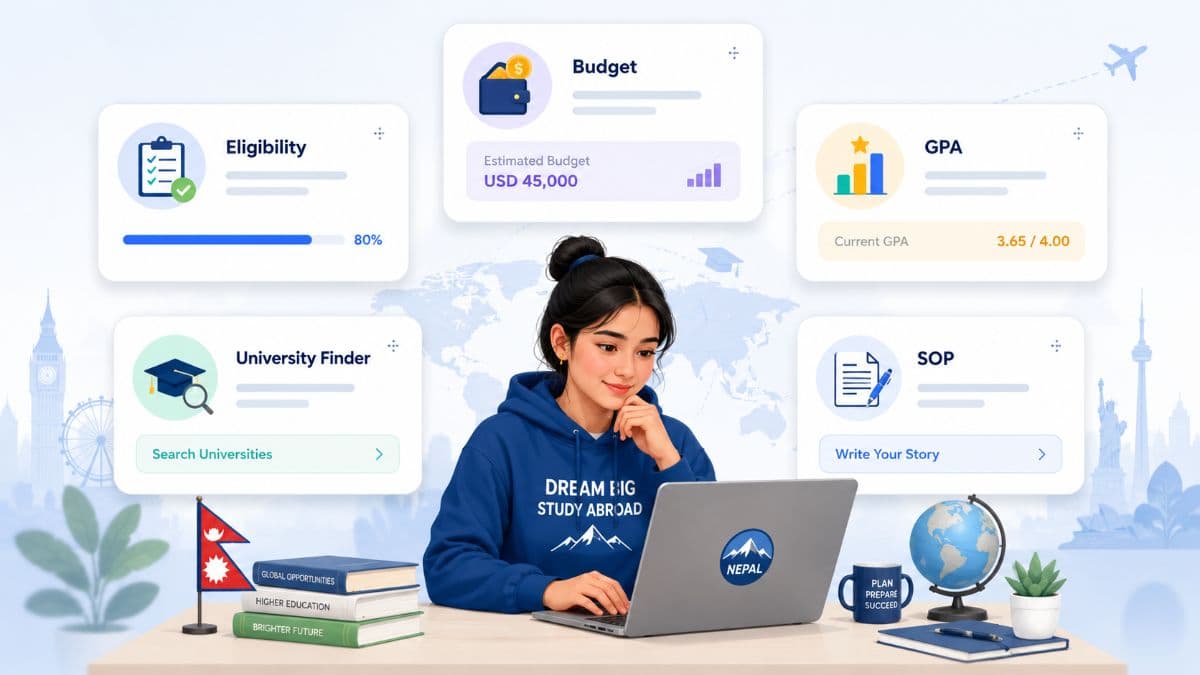
5 Free Study Abroad Tools Every Nepali Student Should Use Before Applying
At EIEC Nepal, we have worked with thousands of Nepali students over the years, and one pattern is clear: most students begin their study abroad journey without structured planning. They come with questions like: which country should I choose, am I eligible, how much budget do I need, what is my GPA, and how should I write my SOP?
These questions are valid, but what many students do not realize is that early-stage clarity significantly improves admission success, visa outcomes, and overall decision quality. Based on our internal counselling data, students who prepare their profile before counselling sessions tend to finalize their destination faster and avoid unnecessary application rejections.
To address this gap, EIEC Nepal has developed a set of free study abroad tools designed specifically for Nepali students. These tools are built from real counselling insights, common rejection patterns, and practical challenges faced during application and visa stages.
You can access the tools here: Free Study Abroad Tools for Nepali Students.
Quick Overview: Which Tool Should You Use First?
| Tool | Main Problem It Solves | Best For | When to Use |
|---|---|---|---|
| Eligibility Checker | Am I eligible to study abroad? | Students unsure about grades, gap, English test or destination | Before choosing a country |
| University Finder | Which university fits my profile? | Students comparing courses, countries and budgets | After basic eligibility check |
| Budget Calculator | How much money do I need? | Students and families planning finances | Before finalizing destination |
| GPA Calculator | How do I understand my academic score? | Students with percentage, GPA or mixed grading systems | Before university shortlisting |
| SOP Tool | How do I structure my SOP? | Students preparing applications and visa documents | Before writing the final SOP |
Why Study Abroad Tools Matter for Nepali Students
From our counselling experience, one of the biggest inefficiencies in the study abroad process is lack of preparation. Students often visit consultancies without knowing their academic standing, realistic budget range, or suitable course options.
This leads to:
- Applying to universities outside their eligibility range
- Choosing countries based on trends rather than profile fit
- Underestimating total financial requirements
- Weak SOPs that do not align with visa expectations
Students who use structured tools before counselling tend to ask better questions such as:
- Which country aligns with my academic profile and budget?
- Is my GPA competitive for my target universities?
- What is my realistic financial commitment?
- Which universities are achievable, not just aspirational?
- How should I position my SOP for both admission and visa?
This preparation leads to faster decision-making and stronger applications.
1. Eligibility Checker: Know Where You Stand First
One of the most common mistakes we observe at EIEC Nepal is students selecting a destination before understanding their eligibility. This often results in wasted time, rejected applications, or unnecessary course changes.
The Eligibility Checker is designed based on real admission screening criteria used during counselling. It helps students evaluate whether their profile aligns with general study abroad requirements.
| Eligibility Factor | Why It Matters |
|---|---|
| Academic level | Different programs (diploma, bachelor, master’s) have different entry thresholds. |
| Grades or GPA | Academic performance directly impacts admission probability. |
| English test readiness | IELTS or PTE scores are often mandatory for admission and visa. |
| Study gap | Unexplained gaps can weaken both admission and visa applications. |
| Budget readiness | Financial capacity affects both university selection and visa approval. |
Based on our internal data, students who assess eligibility early reduce application rejection risk significantly.
2. University Finder: Stop Choosing Universities Randomly
Many Nepali students choose universities based on peer influence or social media trends. However, our counselling data shows that mismatched university selection is one of the leading causes of application rejection.
The University Finder is built to guide students toward realistic and profile-based choices.
| Common Mistake | Better Approach |
|---|---|
| Following friends blindly | Matching course and entry requirements with your profile |
| Choosing only by country popularity | Evaluating city, university ranking, and course relevance |
| Focusing only on low tuition | Balancing cost with quality and visa success rate |
| Ignoring deadlines | Planning applications based on intake timelines |
At EIEC Nepal, we emphasize that the right university is not the most popular one, but the one that aligns with your academic profile, budget, and long-term goals.
3. Budget Calculator: Calculate Total Cost, Not Only Tuition
Financial miscalculation is one of the most critical issues we see during visa preparation. Many students initially focus only on tuition fees, but real costs are significantly higher.
Our Budget Calculator is designed using real student expense patterns observed during counselling and visa processing.
| Cost Area | Why It Is Often Missed | Why It Matters |
|---|---|---|
| Living expenses | Students focus only on tuition | Living costs vary significantly by city and lifestyle |
| Insurance | Discussed late in the process | Mandatory in many countries |
| Visa and medical fees | Not included in tuition | Essential for application approval |
| Travel and settlement | Ignored during planning | Initial expenses after arrival are unavoidable |
| Emergency funds | Families plan minimum budget | Unexpected costs are common abroad |
Students who plan full costs early are more likely to avoid visa complications related to financial documentation.
4. GPA Calculator: Understand Your Academic Profile Clearly
Nepali grading systems vary widely, which creates confusion when comparing with international university requirements. This often leads to unrealistic expectations or missed opportunities.
The GPA Calculator helps standardize your academic understanding for planning purposes.
| Student Situation | How GPA Tool Helps |
|---|---|
| Percentage-based results | Provides a clearer academic benchmark |
| Mixed grading systems | Helps compare across universities |
| Scholarship planning | Indicates competitiveness level |
| Uncertain eligibility | Supports early decision-making |
While not a final evaluation, this tool reflects how counsellors initially assess academic profiles during consultations.
5. SOP Tool: Build Your Story Before Writing
From our experience, SOP quality is one of the most underestimated factors in both admission and visa success. Many students either copy templates or write without structure.
The SOP Tool is designed based on real SOP review patterns used during counselling and visa preparation.
| SOP Section | What It Should Explain |
|---|---|
| Academic background | Your previous studies and relevance to your chosen course |
| Course motivation | Why you selected this field |
| Country and university choice | Logical reasoning behind your destination |
| Career plan | Your professional goals after graduation |
| Future intention | Long-term direction aligned with your study plan |
Students who structure their SOP properly tend to present stronger, more credible applications.
The Best Order to Use These Tools
| Step | Tool | Purpose |
|---|---|---|
| Step 1 | Eligibility Checker | Understand readiness |
| Step 2 | GPA Calculator | Clarify academic standing |
| Step 3 | University Finder | Identify suitable options |
| Step 4 | Budget Calculator | Validate financial feasibility |
| Step 5 | SOP Tool | Prepare application narrative |
Common Mistakes These Tools Help You Avoid
- Choosing a country without eligibility assessment
- Applying beyond realistic academic range
- Underestimating total financial requirements
- Misinterpreting GPA or grading systems
- Submitting weak or generic SOPs
- Delaying documentation preparation
- Relying only on peer advice
Are Free Study Abroad Tools Enough?
These tools are designed for structured planning, not final decision-making. Admission and visa outcomes depend on multiple factors including documentation quality, timing, and compliance with official requirements.
Based on our experience, the most effective approach is to use these tools first and then consult with an experienced counsellor for a detailed profile evaluation.
Why EIEC Nepal Built These Tools
EIEC Nepal developed these tools based on real counselling insights, student challenges, and application outcomes observed over time. Our goal is to make study abroad planning more transparent, data-informed, and student-focused.
These tools reflect practical knowledge gained from working directly with Nepali students, not generic global templates.
Try them here: Free Study Abroad Tools for Nepali Students.
Frequently Asked Questions
Are study abroad tools accurate?
They are accurate for planning purposes and reflect real counselling frameworks, but final decisions depend on universities and visa authorities.
Can an eligibility checker guarantee admission?
No. It provides a general assessment, not a final decision.
Can a budget calculator give exact costs?
No. It provides realistic estimates based on typical student expenses.
Is a GPA calculator enough?
No. Universities may use their own evaluation methods.
Should I use an SOP tool?
Yes, for structure and clarity, but final SOPs should be personalized and reviewed.
Final Thoughts
Studying abroad is not just about choosing a country—it is about making informed decisions at every stage. Students who plan early, understand their profile, and align their choices strategically are more likely to succeed.
The tools developed by EIEC Nepal are designed to give Nepali students a structured starting point based on real experience and practical insights. Use them to prepare, then move forward with confidence.
Recommended Services & Next Steps
Need study abroad guidance?
Talk to Espot International Education Consultancy
EIEC Nepal helps students with counselling, university selection, IELTS/PTE preparation, SOP guidance, scholarships, documentation review and student visa guidance from Kathmandu and branches across Nepal.
Contact EIEC