IELTS vs PTE for Nepali Students: Which Test Should You Choose?
Confused between IELTS and PTE? Compare format, scoring, result time, difficulty, fees and best choice for Nepali students planning to study abroad.
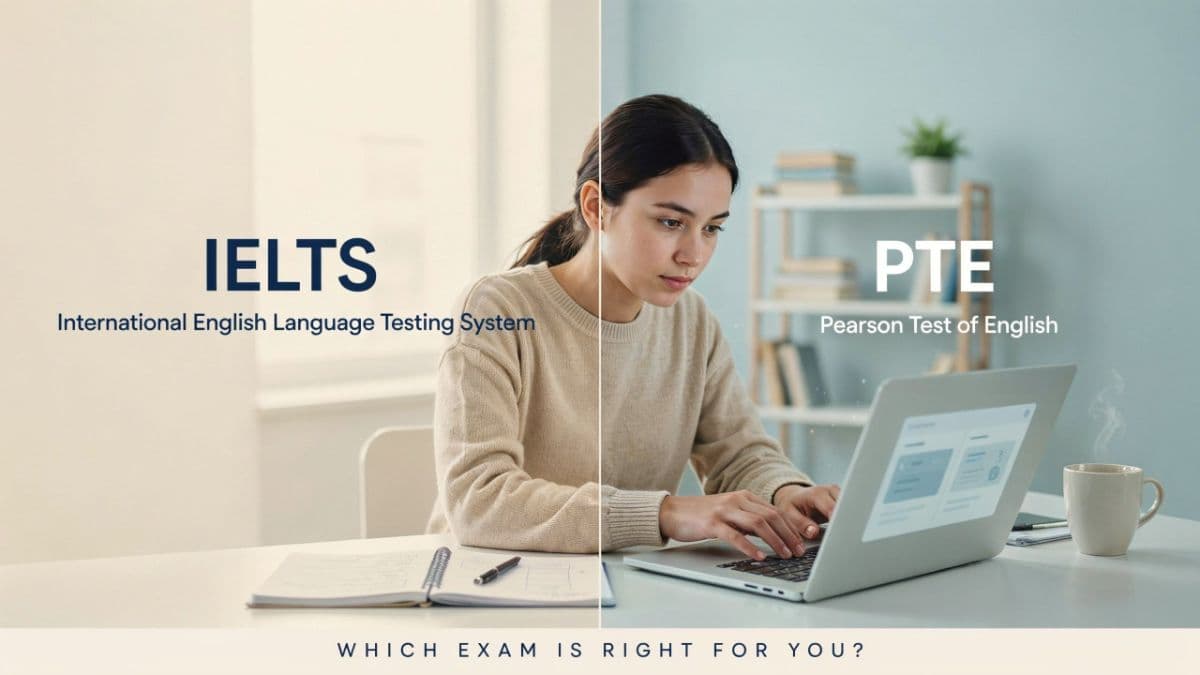
IELTS vs PTE for Nepali Students: Which Test Should You Choose?
Choosing between IELTS and PTE is not just about picking an English test. For Nepali students, it directly affects admission chances, visa outcomes, preparation time and even confidence during the application process.
At EIEC Nepal, after working with hundreds of student profiles across Australia, the UK, Canada and other destinations, we have observed that the “right test” is rarely about which one is easier. It is about which test aligns with your academic background, communication style and application timeline.
This guide goes beyond basic comparisons. It combines official test structures with real patterns we see among Nepali students to help you make a smarter, more personalized decision.
Quick Comparison: IELTS vs PTE
| Factor | IELTS | PTE Academic |
|---|---|---|
| Full form | International English Language Testing System | Pearson Test of English Academic |
| Main skills tested | Listening, Reading, Writing, Speaking | Speaking & Writing, Reading, Listening |
| Score scale | Band score from 0 to 9 | Score from 10 to 90 |
| Speaking test | Human examiner interaction | Computer microphone-based speaking |
| Result time | Varies by format | Typically faster |
| Best for | Students comfortable with natural conversation | Students comfortable with structured computer tasks |
| Challenge | Subjective perception in speaking/writing | Strict timing and integrated scoring |
What Most Nepali Students Get Wrong (EIEC Insight)
Based on counselling sessions at EIEC Nepal, one of the biggest misconceptions is that PTE is “easier” and IELTS is “harder.” In reality:
- Students from Nepali-medium or mixed-medium backgrounds often perform better in IELTS Speaking because they can explain ideas naturally.
- Students from English-medium schools with strong typing skills often perform better in PTE.
- Students who rush into PTE without typing practice often lose marks in writing and listening tasks.
- Students who fear speaking exams sometimes underperform in IELTS despite having strong English.
This is why choosing based on your personal strengths is more important than following trends.
What Is IELTS?
IELTS is a globally recognized English test used for study, work and migration. It evaluates four core skills separately, which gives students a clearer understanding of their strengths and weaknesses.
| IELTS Section | Time | What It Tests |
|---|---|---|
| Listening | About 30 minutes | Understanding spoken English in real-life contexts |
| Reading | 60 minutes | Academic reading and comprehension |
| Writing | 60 minutes | Structured writing and argument development |
| Speaking | 11–14 minutes | Face-to-face communication skills |
EIEC Insight: Students who actively participate in discussions, presentations or interviews tend to perform better in IELTS Speaking compared to those who rely only on memorization.
What Is PTE Academic?
PTE Academic is a fully computer-based test that evaluates English through integrated tasks. It is designed to measure how well students can use English in academic environments.
| PTE Section | What It Includes | What Students Should Know |
|---|---|---|
| Speaking & Writing | Read aloud, repeat sentence, describe image, essay | Pronunciation, fluency and typing speed are critical |
| Reading | Multiple choice, reorder paragraphs | Grammar and vocabulary accuracy matter |
| Listening | Summarize spoken text, dictation | Attention and memory play a major role |
EIEC Insight: Many Nepali students lose marks in PTE not because of weak English, but because of poor typing speed and unfamiliarity with the test interface.
IELTS vs PTE: Which One Is Easier?
Instead of asking which test is easier, ask which test matches your strengths.
| If This Sounds Like You | IELTS May Fit Better | PTE May Fit Better |
|---|---|---|
| I speak confidently in conversations | Yes | Not necessarily |
| I prefer structured, predictable tasks | Somewhat | Yes |
| I type fast and accurately | Helpful | Very important |
| I get nervous in face-to-face speaking | May be challenging | May feel easier |
Scoring Difference: IELTS Band vs PTE Score
IELTS uses a band system, while PTE uses a numerical scale. However, what matters is how universities interpret these scores.
EIEC Insight: Some universities may accept both tests but have slightly different score expectations. For example, a course requiring IELTS 6.5 may expect a higher equivalent PTE score depending on the institution.
IELTS vs PTE Fees in Nepal
Fees vary depending on provider and test type. Students should always verify official sources before booking.
EIEC Insight: Many students delay booking due to confusion about fees. Early planning helps secure preferred test dates and reduces last-minute stress.
Which Test Is Better for Australia?
Australia accepts both IELTS and PTE widely, but the choice depends on your profile.
| Student Type | Better Option | Why |
|---|---|---|
| Tech-savvy student | PTE | Faster results and structured format |
| Strong communicator | IELTS | Natural speaking advantage |
Common Mistakes Nepali Students Make
| Mistake | Why It Happens | Better Approach |
|---|---|---|
| Following friends blindly | Peer influence | Assess your own strengths |
| Ignoring typing practice | Underestimating PTE requirements | Practice typing daily |
| Skipping mock tests | Lack of awareness | Take diagnostic tests early |
Simple Decision Framework
| Question | Direction |
|---|---|
| University requires specific test? | Follow requirement |
| Comfortable with computers? | Consider PTE |
| Prefer human interaction? | Consider IELTS |
Preparation Strategy for Nepali Students
Preparation should be personalized, not generic.
| Stage | Focus |
|---|---|
| Start | Diagnostic test |
| Middle | Skill improvement |
| Final | Mock tests and timing |
How EIEC Nepal Can Help
EIEC Nepal provides personalized guidance based on real student outcomes, not generic advice. Our counsellors evaluate your academic background, English level and destination goals before recommending IELTS or PTE.
Explore our preparation support here: IELTS/PTE Preparation at EIEC Nepal.
Use our planning tools here: Free Study Abroad Tools.
Final Verdict: IELTS or PTE?
There is no universal answer. The best test is the one that aligns with your strengths, preparation style and study abroad plan.
At EIEC Nepal, we recommend making this decision based on data, mock performance and expert guidance—not assumptions.
Choose smart, prepare strategically and your English test will become a strength, not a barrier.
Recommended Services & Next Steps
Language Preparation Center
IELTS & PTE Academic classroom courses in Putalisadak.
IELTS Course Details
Schedules, resources, scoring guides, and mock trials.
PTE Prep Course Details
AI software test evaluation and timed computer mocks.
Browse All Resources
Access study planning manuals and exam guides.
Need study abroad guidance?
Talk to Espot International Education Consultancy
EIEC Nepal helps students with counselling, university selection, IELTS/PTE preparation, SOP guidance, scholarships, documentation review and student visa guidance from Kathmandu and branches across Nepal.
Contact EIEC