Recommendation Letter Sample for Study Abroad Applications
Learn how to prepare a strong recommendation letter for study abroad applications with sample structure, recommender checklist, weak vs strong example
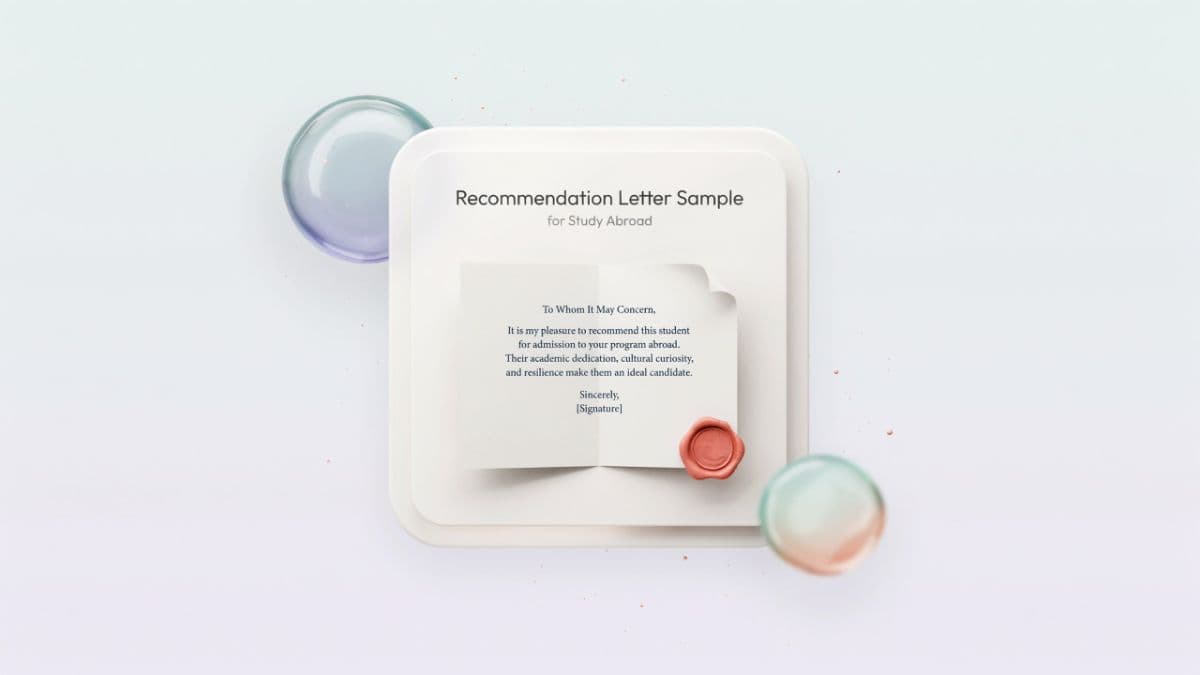
A recommendation letter can strengthen a study abroad application when it adds something your marksheet cannot show.
Grades show academic result. A recommendation letter shows academic behavior.
A strong letter can explain how a student thinks, participates, handles responsibility, solves problems, improves over time, and fits the chosen course. A weak letter only says the student is hardworking, sincere, and disciplined without proof.
For Nepali students, recommendation letters are often prepared too casually. Many letters use the same template for every student. That makes the letter look generic and less useful.
A strong recommendation letter should be specific, factual, and connected to the course or program the student is applying for.
What is a recommendation letter?
A recommendation letter is a written statement from a teacher, lecturer, counselor, employer, supervisor, or academic official who knows the student’s work.
Depending on the application, it may also be called:
Reference letter
Academic reference
Teacher recommendation
Counselor recommendation
Employer recommendation
Letter of recommendation
The purpose is to support the student’s application with an outside perspective.
Why recommendation letters matter
A recommendation letter helps universities understand:
How the student performs in class
How the student behaves academically
Whether the student is serious and consistent
Whether the student has relevant skills
Whether the student is suitable for the chosen course
Whether the student has potential beyond grades
💡 The Reality: Good recommendation letters are not long praise essays. They are evidence-based academic support documents.
Who should write your recommendation letter?
Choose someone who knows you well enough to write specific details. Good options include:
Subject teacher
College lecturer
Academic coordinator
School counselor
Project supervisor
Internship supervisor
Employer or line manager
Department head
The best recommender is not always the person with the highest title. It is the person who can write the most specific and honest letter.
Academic vs professional recommendation
TypeBest forWritten byAcademic recommendationBachelor’s, Master’s, university admissionTeacher, lecturer, counselor, department headProfessional recommendationMBA, work-experience programs, mature applicantsEmployer, supervisor, managerCharacter referenceLimited use, usually weaker for academicsCommunity leader or non-academic contact
For most students applying after +2 or Bachelor’s, an academic recommendation is usually more useful than a general character letter.
What a strong recommendation letter should include
A good letter should include:
SectionPurposeRecommender introductionShows who is writing and how they know the studentRelationship with studentExplains teaching/supervision contextAcademic performanceDescribes subject ability and learning behaviorSkills and qualitiesShows relevant strengths with examplesCourse suitabilityConnects the student to the chosen programSpecific evidenceGives examples, not generic praiseFinal recommendationClearly supports the student’s applicationContact detailsAllows verification if needed
Sample recommendation letter structure
This is a sample structure for educational use. The actual letter should be written honestly by the recommender.
Sample format
To the Admissions Committee,
I am pleased to recommend [Student Full Name] for admission to [Course/Program Name] at your institution. I have known [him/her/them] for [duration] as [his/her/their] [subject teacher / lecturer / supervisor] at [Institution Name].
During this period, I taught [Student Name] in [Subject/Course Name] and observed [his/her/their] academic performance, classroom participation, and approach to learning. [Student Name] showed consistent interest in [relevant subject area] and demonstrated the ability to understand concepts, complete assignments responsibly, and participate in academic discussions.
One quality that stands out is [specific quality], which I observed when [specific example]. This showed [his/her/their] ability to [skill or behavior relevant to chosen course].
[Student Name] is applying for [Course Name], and I believe this program matches [his/her/their] academic interest and future goals. Based on [his/her/their] performance and attitude, I believe [he/she/they] has the potential to succeed in an international academic environment.
I therefore recommend [Student Full Name] for admission to your program. Please feel free to contact me if further information is required.
Sincerely,
[Recommender Name]
[Designation]
[Institution/Organization Name]
[Email Address]
[Phone Number]
[Date]
Weak vs strong recommendation examples
Example 1: Generic praise
❌ Weak: He is a very hardworking, sincere, honest, and disciplined student. I strongly recommend him.
(This is weak because it gives no evidence.)
Strong: In my Business Studies class, he consistently submitted assignments on time and showed strong interest in case-based discussions. During a group presentation on market segmentation, he helped organize the research and explained the findings clearly to the class.
(This is stronger because it gives a specific example.)
Example 2: Course fit
❌ Weak: She is suitable for any course she chooses.
Strong: She is suitable for a Business Analytics program because she has shown interest in both business decision-making and data interpretation. Her performance in accounting and computer application subjects suggests that she can handle a course combining business and technology.
(This connects the recommendation to the target course.)
Example 3: Personal quality
❌ Weak: He has good leadership skills.
Strong: He demonstrated leadership during a semester project by dividing tasks among group members, tracking deadlines, and presenting the final work confidently. His ability to coordinate the group improved the quality of the final submission.
(This proves the quality instead of just naming it.)
What students should give to the recommender
Students should not write fake letters for recommenders. But they can help the recommender by providing accurate information. Give your recommender:
Your full name as per passport
Course and university name
Academic transcript
CV or resume
SOP draft, if available
Major achievements
Projects or assignments completed under them
Deadline and submission method
Any required format from the university
This helps the recommender write a more specific letter.
Recommender checklist
Before finalizing the letter, the recommender should check:
[ ] Is the student’s name correct?
[ ] Is the course or program name correct?
[ ] Is the relationship with the student clearly mentioned?
[ ] Are examples specific?
[ ] Does the letter avoid exaggerated claims?
[ ] Is the tone professional?
[ ] Is the letter on official letterhead if possible?
[ ] Is the date included?
[ ] Are contact details included?
[ ] Is the signature included?
[ ] Does the letter match the student’s actual profile?
Nepal-specific recommendation letter issues
Same template for every student: Many institutions issue almost identical letters. This weakens the value of the recommendation.
Too much character praise: Words like honest, sincere, disciplined, and hardworking are common. They are not enough without examples.
No course connection: The letter should explain why the student fits the selected course or field.
Missing official details: A letter without designation, institution name, contact details, date, or signature can look incomplete.
Student writes the full letter alone: A student may provide details, but the final letter should reflect the recommender’s real view.
No proof of relationship: The letter should clearly say how the recommender knows the student.
Academic recommendation letter format
For academic applications, the letter should usually mention:
Subject taught
Academic performance
Classroom behavior
Assignment or project quality
Communication skills
Analytical ability
Attendance or consistency, if relevant
Suitability for the chosen course
Example: I taught [Student Name] in Economics during Grade 12. During the course, she showed strong interest in market behavior, consumer demand, and business decision-making. Her final project on local consumer purchasing patterns showed her ability to collect information, organize findings, and present them clearly.
Professional recommendation letter format
For work-experience applicants, the letter should mention:
Job title
Employment duration
Main responsibilities
Work behavior
Technical or professional skills
Communication and teamwork
Reliability
Relevance to intended course
Example: As an administrative assistant, he handled client records, appointment schedules, and basic reporting tasks. His exposure to office systems and customer communication helped him develop an interest in business operations, which connects with his plan to study Business Management.
How long should a recommendation letter be?
A practical recommendation letter is usually one page. It should be long enough to provide context and examples, but not so long that it becomes repetitive.
A strong letter is not measured by length. It is measured by specificity.
Should the letter be on letterhead?
Where possible, yes. A stronger letter usually includes:
Official letterhead
Institution or company name
Recommender designation
Contact details
Date
Signature
Stamp, if available
If the application portal requires online submission, follow the university’s instructions.
Can a recommendation letter be translated?
If the original letter is not in English and the university requires English documents, a translation may be needed. The translation should follow the institution’s rules. Some universities may also require the original document along with the translated version.
Do not translate or modify the letter in a way that changes the recommender’s meaning.
Common mistakes to avoid
Mistake 1: Using vague praise — Avoid only writing “good student” or “hardworking student.” Add examples.
Mistake 2: No academic evidence — Mention subjects, projects, assignments, classroom behavior, or performance.
Mistake 3: Over-exaggeration — Do not call every student exceptional, outstanding, or top-ranked unless it is true and supported.
Mistake 4: Wrong course name — Always check the program name before submission.
Mistake 5: Missing recommender details — Name, designation, institution, email, and phone number should be included where possible.
Mistake 6: Submitting late — Many application systems require the recommender to submit directly. Ask early.
Strong recommendation letter checklist
A strong recommendation letter should answer:
Who is recommending the student?
How does the recommender know the student?
What subject, work, or activity connects them?
What specific qualities did the student show?
What evidence supports those qualities?
Why is the student suitable for the chosen course?
Is the recommendation honest and professional?
Can the recommender be contacted if needed?
How recommendation letters connect with SOP
Your SOP and recommendation letter should support each other.
Example 1: If your SOP says you are interested in business analytics, a recommendation letter from a Business or Computer teacher can support that by mentioning your performance in related subjects or projects.
Example 2: If your SOP says you are a strong communicator, the recommender can support that with a presentation, project, or classroom example.
The documents should not look disconnected.
Need help preparing your application documents?
Recommendation letters should be handled carefully because they support your admission profile. A good letter adds credibility to your SOP, academic documents, and course selection.
If you are preparing your study abroad application, our admission counselling team can help you understand what documents are needed and how to organize them.
Explore:
FAQs
Who should write a recommendation letter for study abroad?
A teacher, lecturer, counselor, employer, or supervisor who knows your academic or professional work well should write it.
Can a family member write my recommendation letter?
Usually, no. A family member is not considered an objective academic or professional recommender.
Should I write my own recommendation letter?
You can provide your recommender with details, achievements, CV, and course information, but the final recommendation should reflect the recommender’s honest view.
How many recommendation letters are needed?
It depends on the university and program. Some require one, some require two or more, and some may not require any.
What makes a recommendation letter strong?
Specific examples make a recommendation strong. The letter should explain how the recommender knows you and why you are suitable for the chosen course.
Recommended Services & Next Steps
Need study abroad guidance?
Talk to Espot International Education Consultancy
EIEC Nepal helps students with counselling, university selection, IELTS/PTE preparation, SOP guidance, scholarships, documentation review and student visa guidance from Kathmandu and branches across Nepal.
Contact EIEC